Local authorities are accelerating their digital transformation. While putting procedures online has made access to public services easier, it has also removed the human support that used to guide citizens. The result: nearly one in three users still gives up on a procedure because they do not understand it or cannot master the digital tools.
Today, the challenge is no longer just to digitize, but to recreate support: guide, reassure, explain. This is where artificial intelligence changes the game. Far from being a simple chatbot, AI becomes a true virtual front-desk agent, available 24/7. In 2025, nearly one local authority with more than 3,500 inhabitants out of two has already launched an AI project, 20% of which are specifically dedicated to citizen relations.
The use of AI agents in local governments is therefore rapidly evolving, moving from traditional chatbots to conversational assistants and even internal administrative applications.
1. From Chatbots 1.0 to Conversational Assistants
The limits of early chatbots
For about a decade, local authorities have experimented with chatbots to automate responses to citizens. These first generations, known as Chatbots 1.0, were based on rigid decision trees and simplistic keywords. As soon as a question fell outside the predefined paths, the conversation broke down.
This approach often created frustration. According to a Capterra survey, 53% of users rate their interaction with a chatbot as average to poor, seeing it more as an obstacle than as a help.
The arrival of Generative AI (and RAG) and its boosted performance
Since 2020, the RAG approach (Retrieval-Augmented Generation) has emerged as an answer to these limits. It allows AI to directly use local documents (local urban plans, regulations, guides, FAQs) without retraining models, which perfectly fits the GDPR and data-sovereignty requirements of French local authorities.
Unlike old chatbots, generative AI — such as the Cleed.ai solution, already deployed for example in Levallois, one of the first cities to roll out a GenAI solution — does not just repeat pre-written answers. It can “read” and understand the entire body of municipal documentation (website, PDFs, guides) and extract a relevant response.
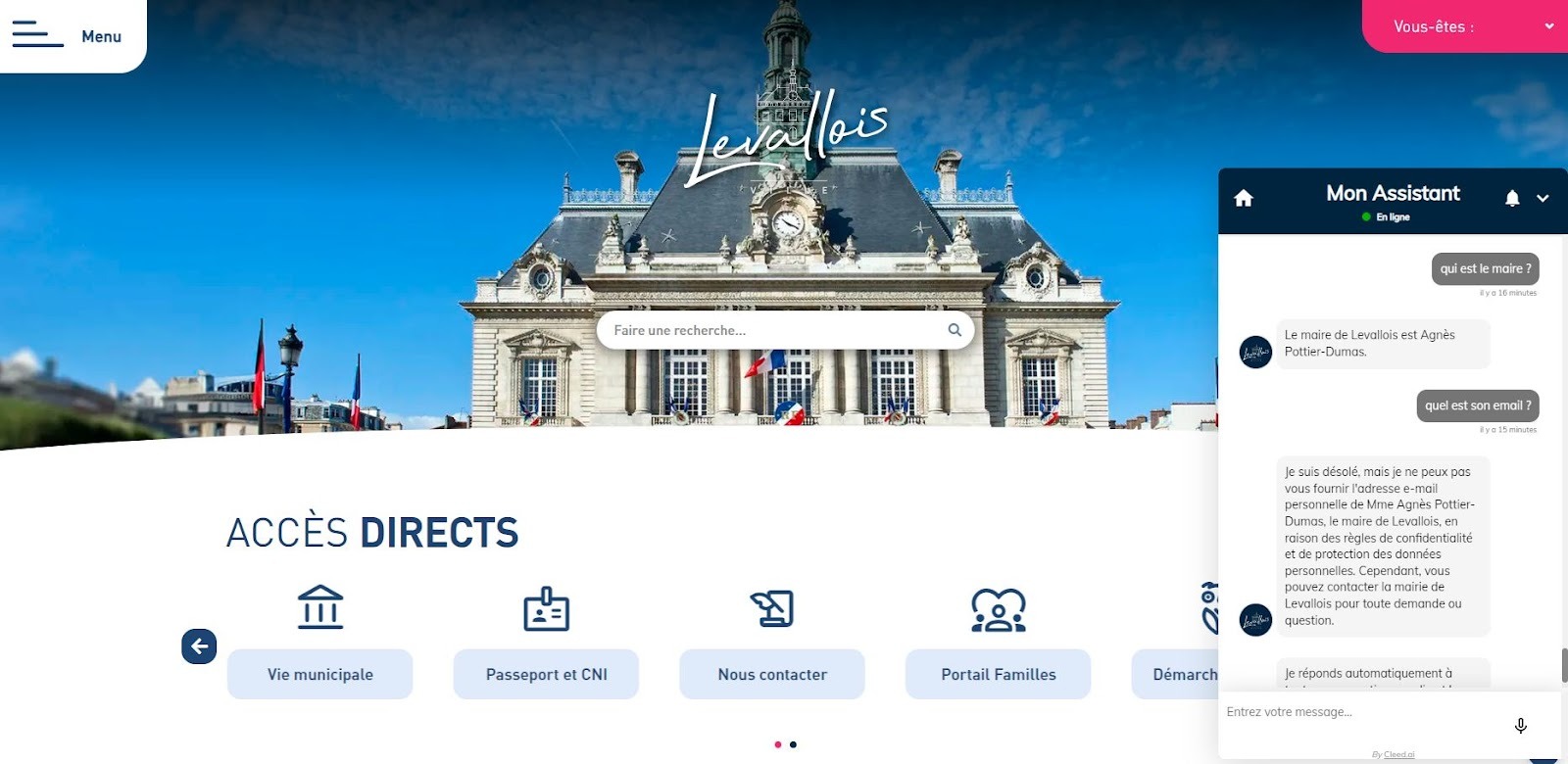
Thanks to this contextual understanding, AI can summarize complex information, for instance from a Local Urban Plan, and present it in clear and accessible language.
These solutions also operate in a closed environment, using only the data provided by the local authority. Answers are systematically grounded in identified sources, which helps control hallucinations and ensure reliability.
Hosting on infrastructures compliant with French and European standards (SecNumCloud, Azure France), along with data anonymization, ensures security and data sovereignty.
Integration of AI agents with business tools
Conversational AI integrates with the existing business tools used by local authorities, such as:
- Calameo for PDF documents, which become interactive publications
- Apidae for entering and distributing tourism data
- OpenAgenda for events
- Ciril for citizen relations and core administrative tools (civil status, schools, finance, HR)
- CRM and GRC solutions such as Genesys for omnichannel contact and interaction management
For example, in Suresnes, Cleed.ai is used as a front-end to enrich citizen responses while exchanging key data with Genesys, ensuring service continuity.
2. Omnichannel Conversational Solutions for Citizens
Local authorities face several major challenges: strong demand for information outside office hours, growing complexity of administrative procedures, very diverse audiences (some uncomfortable with digital tools), and the need for consistent, reliable information across all channels.
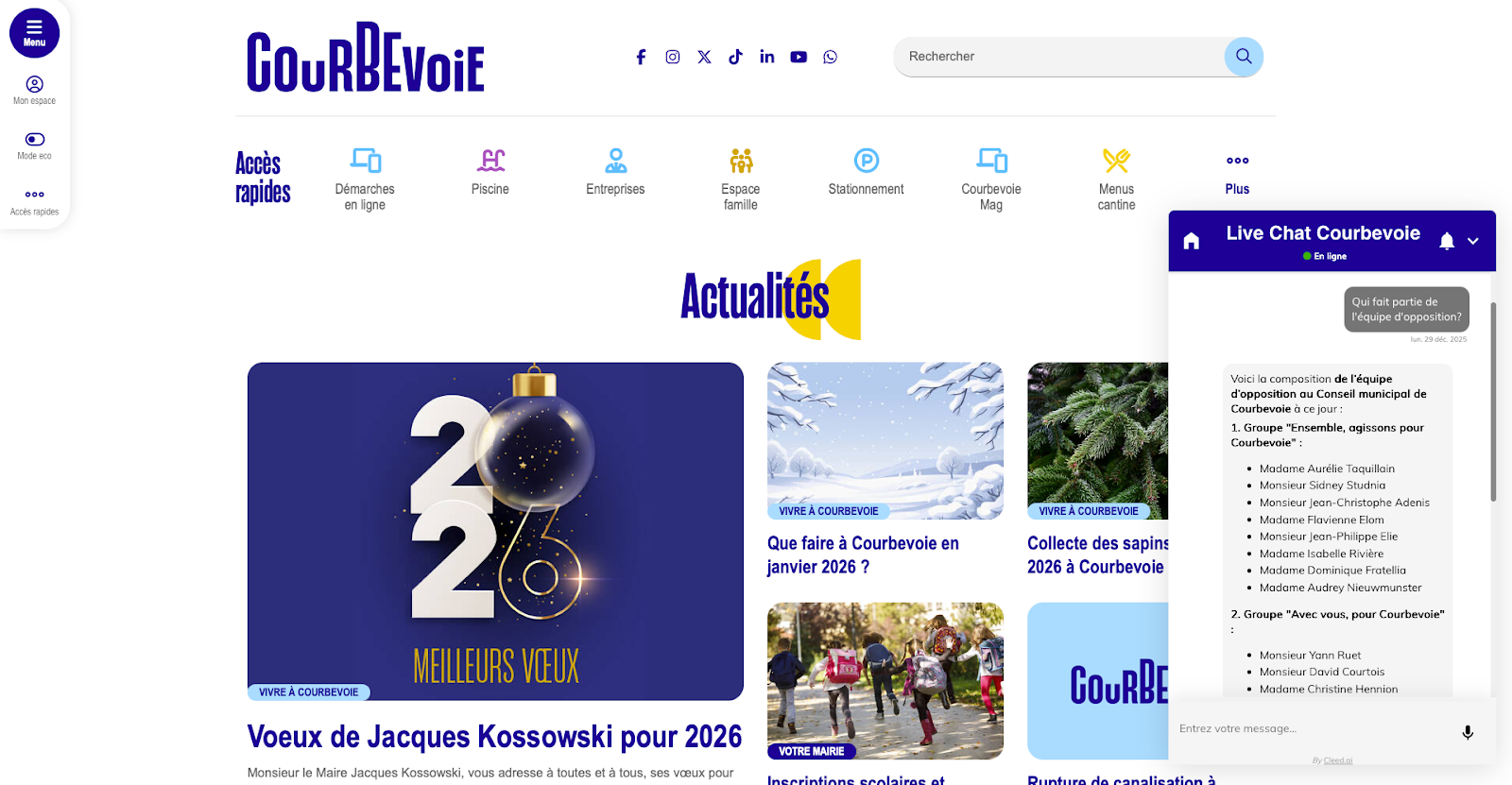
The citizen-facing conversational agent addresses these issues. It is now available across multiple channels — websites, instant messaging, and physical devices — all powered by the same knowledge base to ensure consistent information everywhere.
Instant messaging (Live chat / WhatsApp)
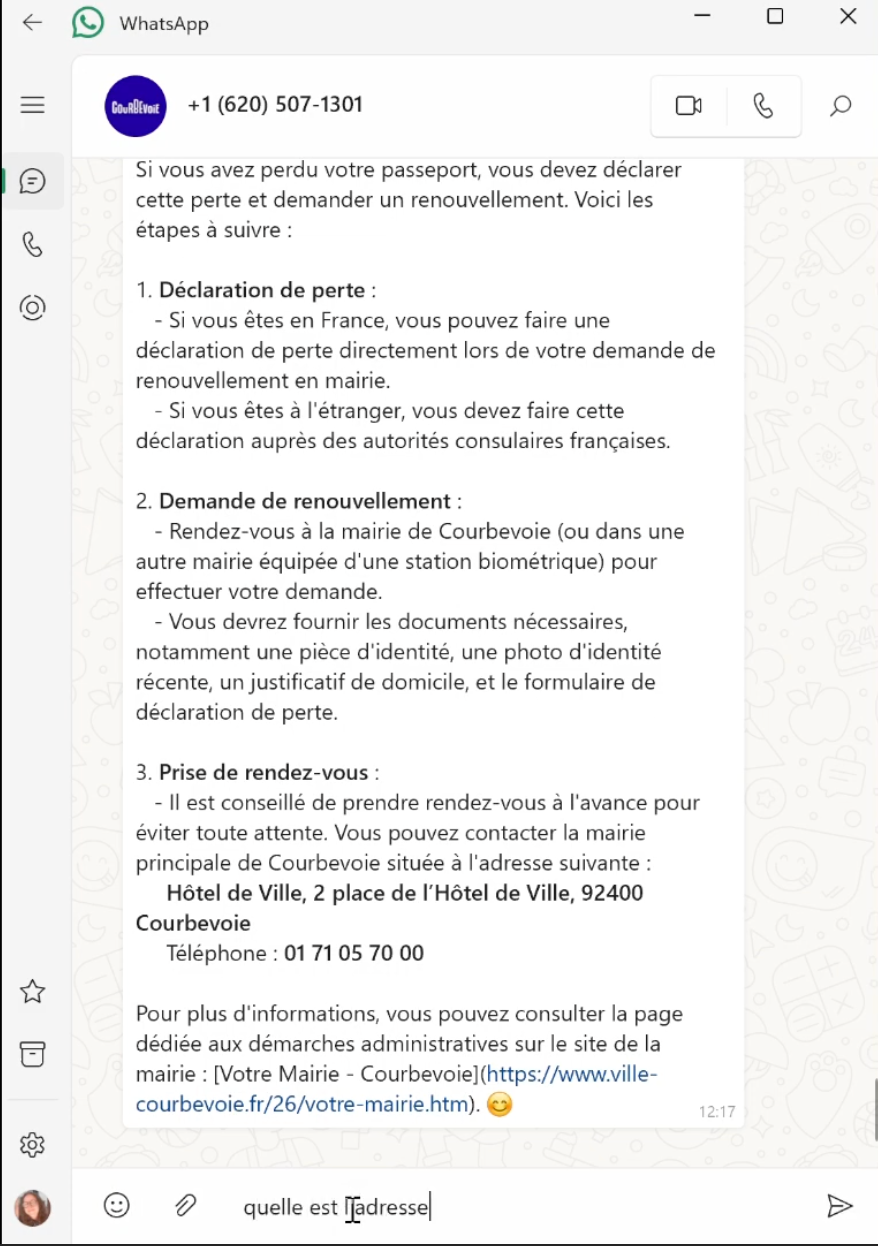
Through secure APIs, conversational AI can interact directly with citizens on their phones 24/7, answering common questions (passports, civil status, administrative procedures) and even booking appointments with municipal services via integrations such as Synbird.
Example: The city of Courbevoie offers, in addition to the Cleed.ai chatbot on its public website, 24/7 access via WhatsApp for passport and civil-status questions.
.
Physical robots and digital inclusion
To support users who are less comfortable with digital tools, physical robots connected to the AI can be deployed on site. They provide natural, voice-based, guided interactions to help citizens complete their procedures in person.
Example: In Rueil-Malmaison, the “Buddy” robot, connected to the Cleed.ai chatbot of the municipal website, assists citizens with their procedures directly at city hall.
In summary, this omnichannel AI agent solution improves the citizen experience by delivering immediate answers, simplified and accessible journeys, and continuous 24/7 service with consistent information across all channels. It also strengthens digital inclusion through in-person assistance while allowing staff to focus on higher-value tasks by reducing repetitive requests.
3. AI as an Assistant for Public Servants to Improve Operational Efficiency
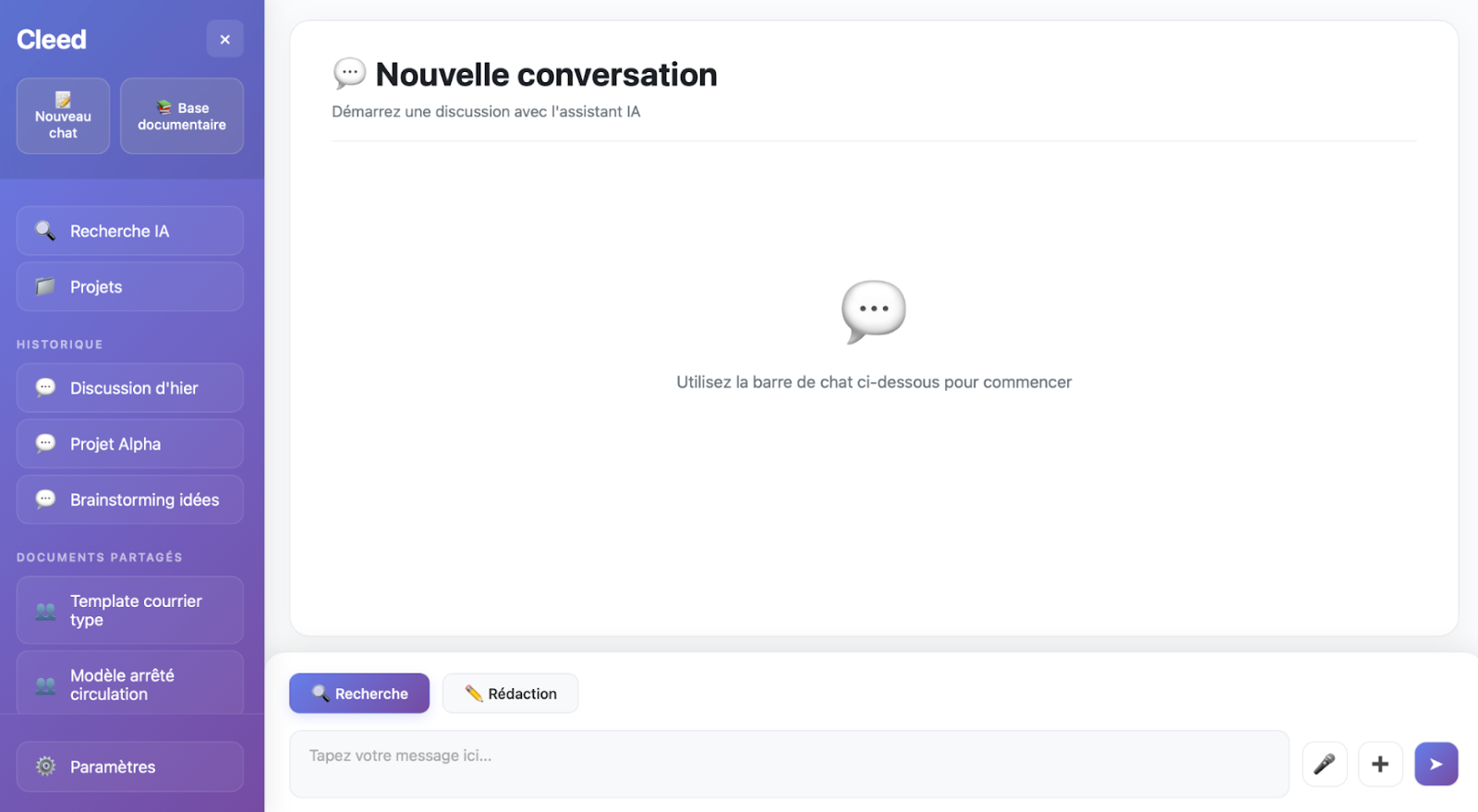
While AI transforms citizen relations, it also becomes a major lever for internal performance. Public servants spend a large part of their time searching for scattered information or drafting standardized administrative documents. Generative AI now offers a dual support: an intelligent search engine and an advanced writing assistant.
A unified search engine for document bases
The first challenge is access to information. Data is often spread across intranets, file servers, SharePoint, OneDrive, and business software. New-generation solutions connect these sources to provide a natural-language “Search” mode. Instead of keywords, an agent can ask:
“What is the procedure for a training leave?” or “Find me the building permit file for X street.”
The AI queries all connected internal and external sources (via RAG) and delivers an immediate answer with exact sources (links to PDFs or intranet pages), ensuring reliability and huge time savings.
Writing assistance and administrative harmonization
The second area is document production. According to an audit by the Métropole du Grand Paris, 84% of the municipalities involved expressed a strong need for assistance in drafting documents (memos, letters, reports, resolutions). An AI assistant meets this need through:
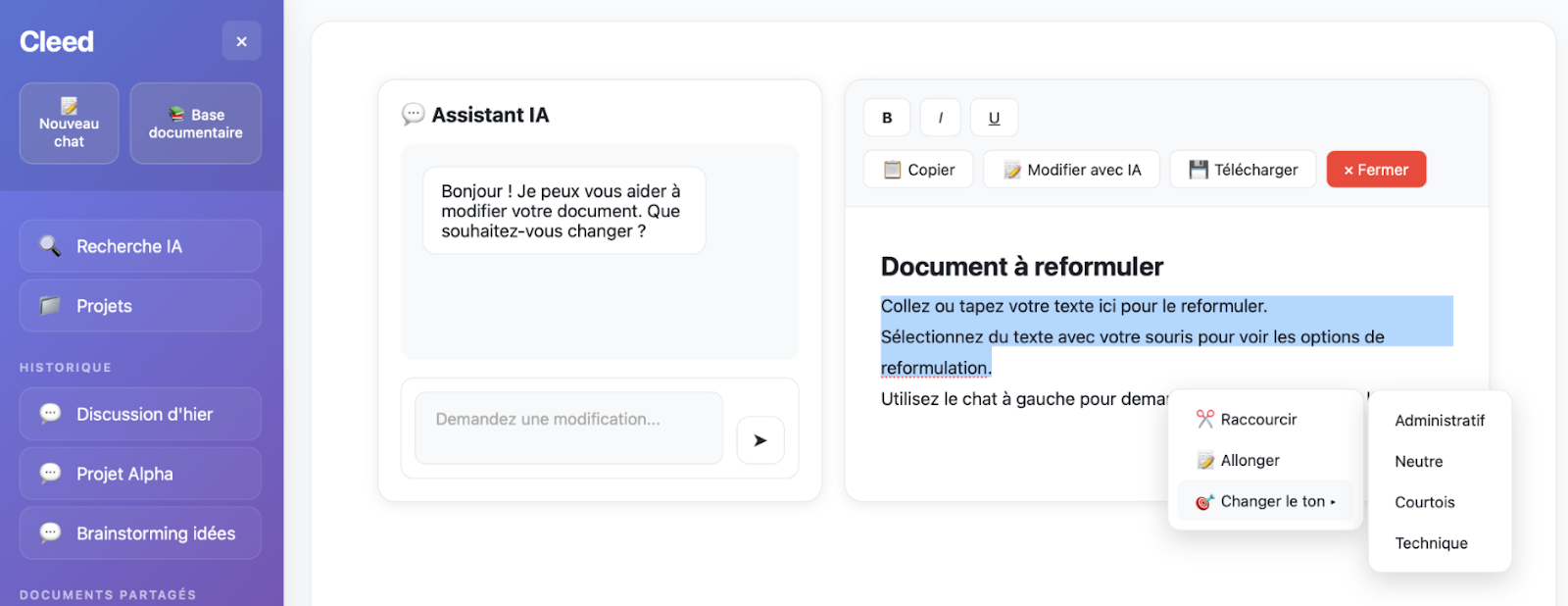
- Contextual rewriting: An agent can submit a text and ask the AI to rewrite it in a specific tone (Administrative, Neutral, Courteous, or Technical). An informal sentence can instantly become a compliant administrative formulation.
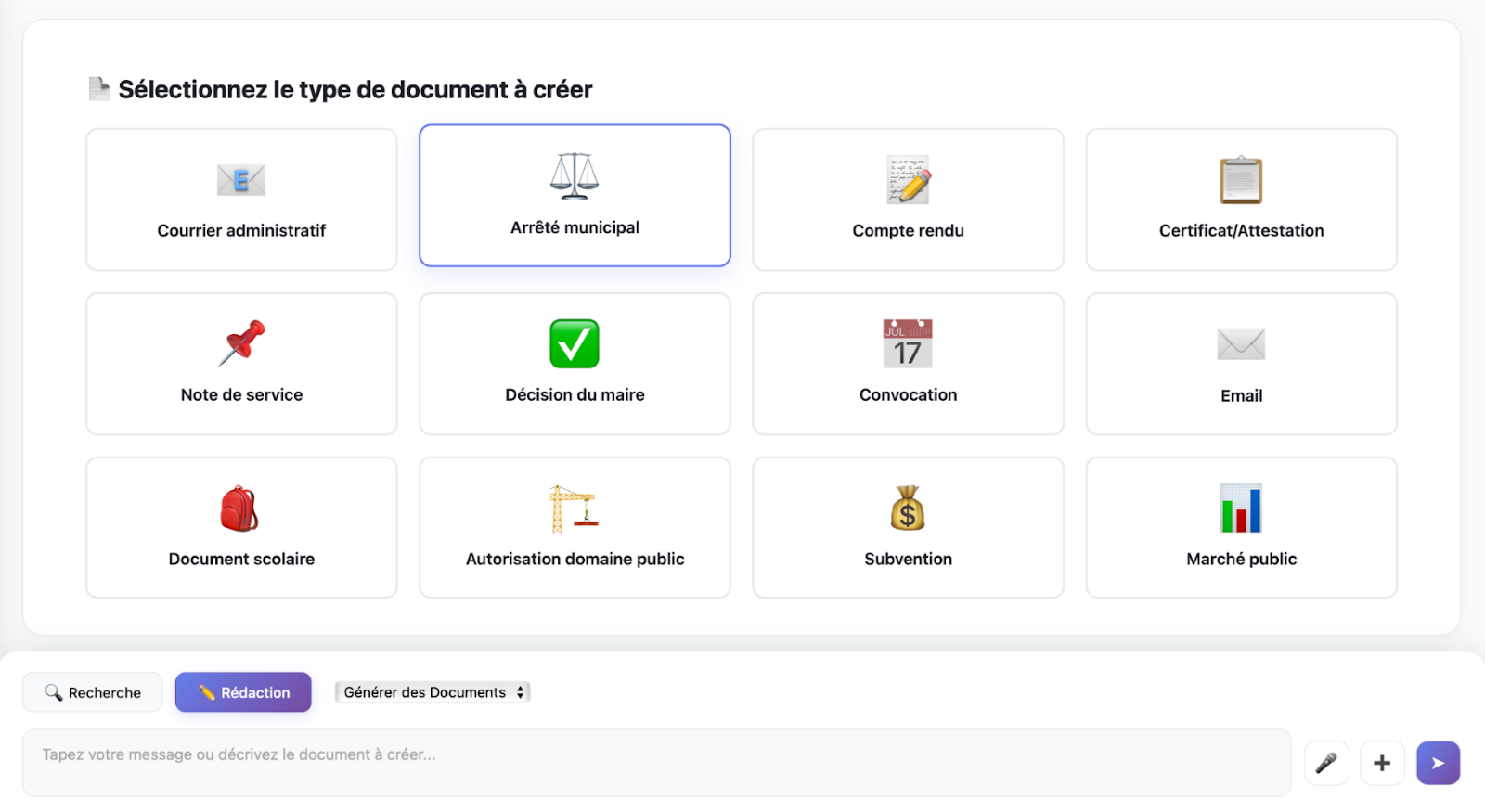
- Generation of standard documents: Using pre-integrated templates (municipal decrees, mayor’s decisions, citizen replies), the AI pre-fills forms and guides the agent to finalize them, reducing repetitive low-value tasks.
The “Metropolitan Appropriation” Program
This dynamic of transformation is at the core of the “Metropolitan Appropriation” program led by the Greater Paris Metropolis. The program is designed as a large-scale experimentation involving up to 130 municipalities and 11 Territorial Public Establishments (EPTs).
A pilot phase is planned and is expected to involve a first group of local authorities (including Antony, Saint-Denis, Vincennes, Rueil-Malmaison, and Argenteuil), with the objective of improving internal information flow and streamlining administrative processes through the use of intelligent assistants.
Conclusion
Integrating artificial intelligence into local authorities is not about replacing public servants, but about amplifying their capabilities. By automating information retrieval and standardized writing, AI frees time for what truly defines public service: professional expertise and human relationships.
However, success depends not only on technology. As highlighted by the Métropole du Grand Paris program, change management is critical. Training and awareness workshops are essential so that staff can adopt these secure, sovereign tools.
For local authorities wishing to define their own AI strategy or assess their digital maturity, the first step is a precise diagnosis of operational needs.