AI Agents to optimize every stage of the educational journey, for students and applicants, as well as teaching and administrative staff
Artificial intelligence (AI) has become a major driver of transformation in the education sector. The global market for AI in education reached $7.57 billion in 2025 and is expected to grow dramatically to $112.30 billion by 2034 according to a study by All in One AI.
This rapid adoption is not a passing trend. AI has become a strategic priority for schools, colleges, and universities. According to a UNESCO survey, nearly 70% of higher education institutions in Europe and North America already have AI usage guidelines in place or are in the process of defining such policies².
Why such strong momentum? Because AI—and particularly educational conversational assistants—addresses several structural challenges facing the education sector:
- A shortage of personalized support, driven by increasing student populations
- A diversification of learner profiles, fueled by online learning, lifelong education, and career transitions
- Evolving pedagogical expectations, with students seeking interactive, personalized, and on-demand learning experiences
- A growing administrative burden, related to admissions, orientation, and student life management
In this context, AI-powered chatbots and virtual tutors are emerging as foundational tools. They automate repetitive tasks, support students 24/7, and enhance the effectiveness of teachers and administrative teams.
1. Optimization of candidate orientation (advising & lead generation) and student administrative management (support services)
According to the 2024 European study “Improving Hybrid Teaching in Higher Education with Chatbots (Hybot),” educational chatbots can reduce up to 80% of recurring administrative requests on simple topics, while increasing user satisfaction. Several practical applications have already been observed.
24/7 Administrative Support
AI Agents instantly answer common questions related to admissions, scholarships, tuition fees, schedules, and campus services. For example, ARBS x Cleed.ai provides schools and families with a conversational assistant that helps identify the right textbooks based on specific needs.

Application Support and personalized orientation
There are several AI‑based or digital agents designed to help candidates find their path, prepare, and track their applications.
Solutions such as Hello Charly offer skills-based orientation support, aligning individual aspirations and backgrounds with the most relevant academic programs.
Enhanced Student Experience
24/7 chatbots and virtual assistants are deployed by many universities and schools to continuously answer students’ questions on practical topics such as housing, dining, campus services, transportation, events, and administrative procedures. They are accessible via websites, apps, or messaging platforms (WhatsApp, Messenger, student portals), making information available at any time, even outside office hours.
Intelligent Lead Nurturing
Connected to CRM systems (such as Oscar Campus, Eudonet / Netanswer, AlumnForce, or Datalumni), AI assistants automatically follow up with prospective students, answer questions, and significantly improve conversion rates.
Student–Alumni Matching
As part of their search for an internship, job, or even a major, students may need to contact alumni to better guide their career choices.Cleed.ai offers a chatbot that enables students, through a conversational experience, to identify alumni whose career paths best match their professional aspirations.
According to several studies, educational chatbots can reduce up to 80%³ of recurring administrative requests on simple topics while increasing overall user satisfaction.
2. Personalized and Continuous Support for Learners
According to some surveys, 88% to 92% of students report using ChatGPT, and 30% use it daily. While some believe that this usage makes students passive and focus only on the negative aspects, AI assistants actually offer many educational benefits.
In fact, one of the main advantages of AI assistants is their ability to provide individualized support on a large scale, which would be difficult to achieve solely through human resources.
24/7 Tutoring and Learning Support
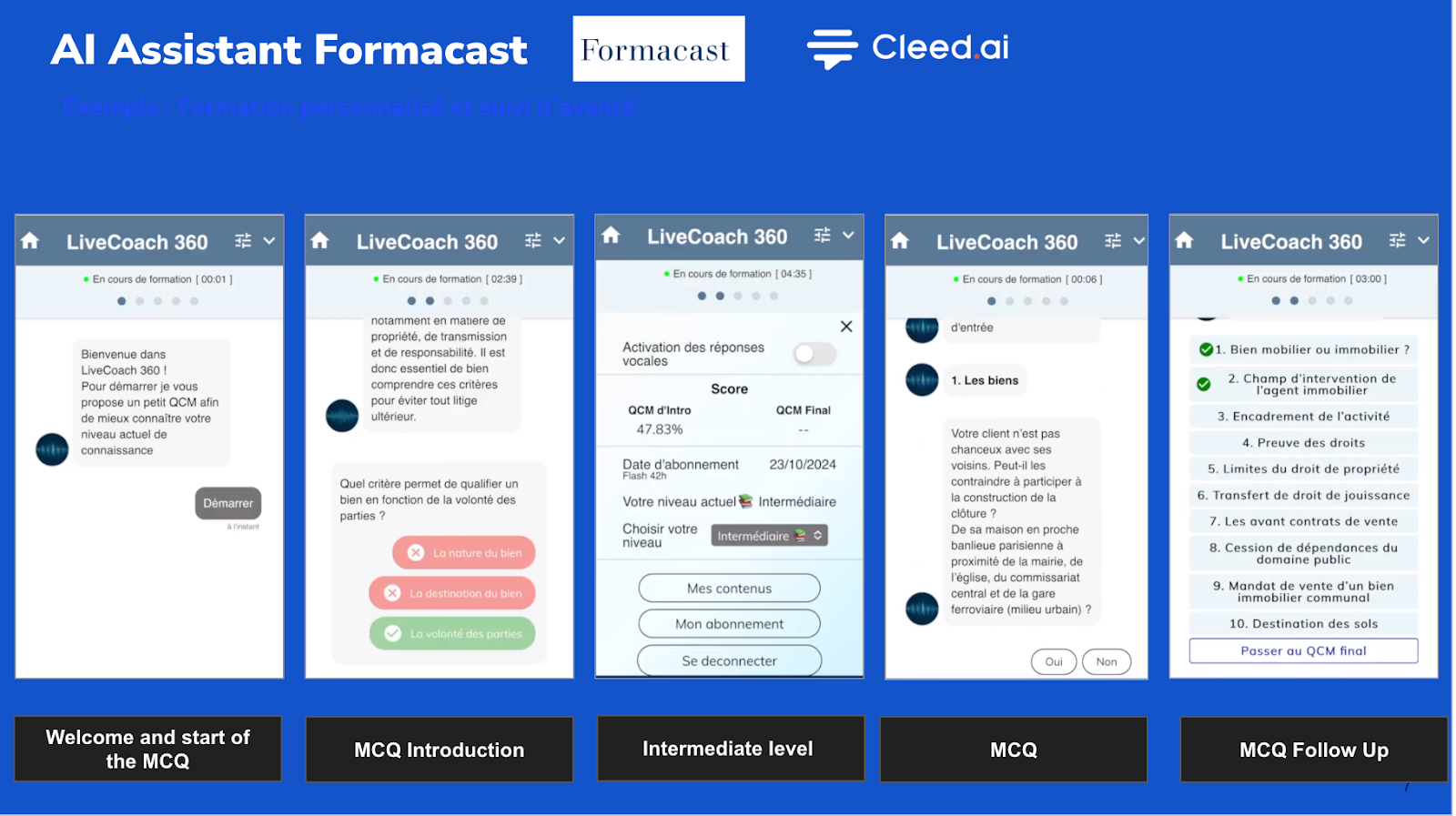
AI agents can explain complex topics—such as mathematics, languages, science, or programming—at any time. Formacast x Cleed.ai, for example, offers an automated training program through an AI conversational coach that supports learners in real estate law and urban planning with personalized, round-the-clock guidance.
In France, ESCP is innovating by adopting ChatGPT Edu to enhance student services and strengthen the performance of its internal processes.
Level-Adaptive Explanations
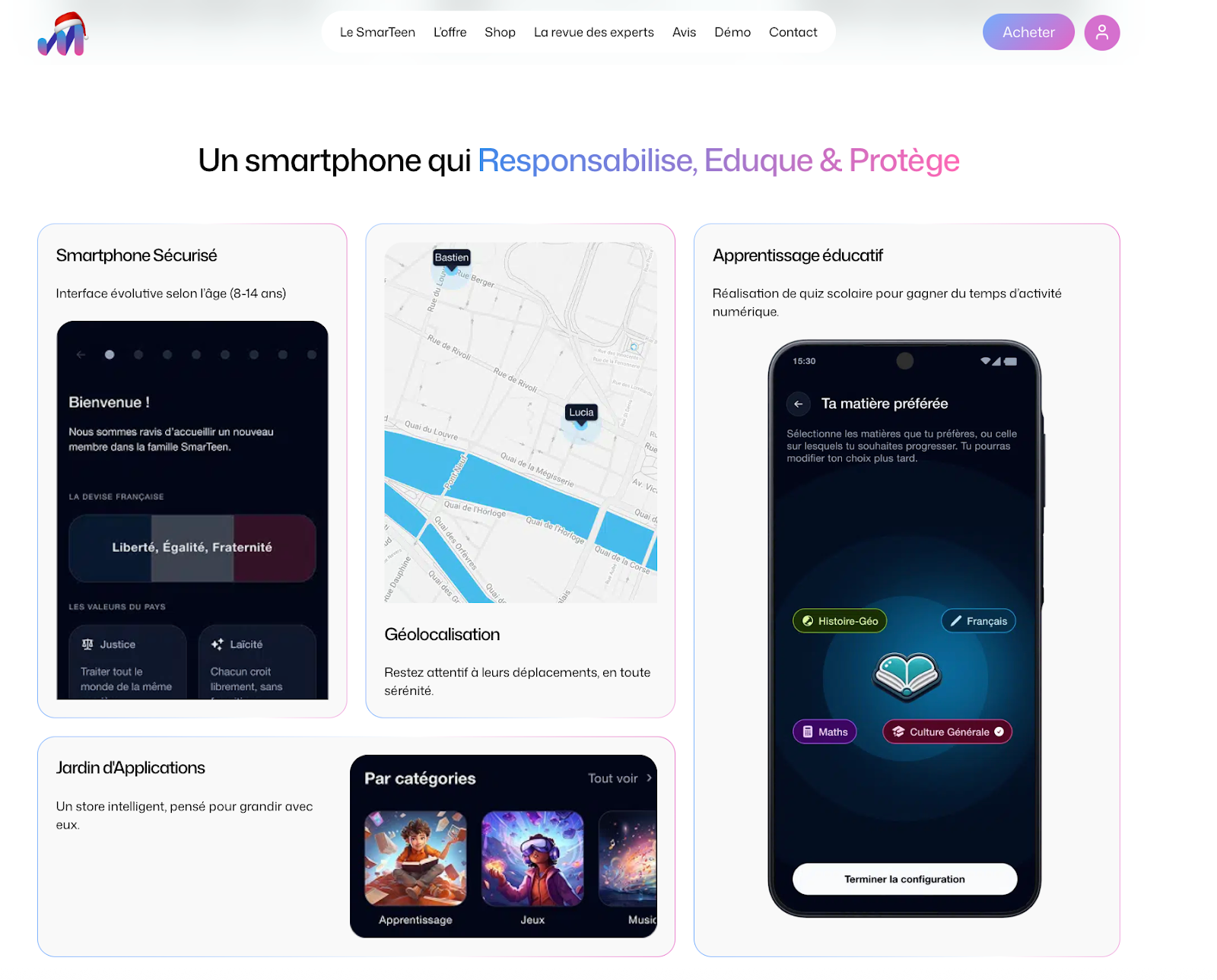
Unlike standardized learning content, AI adjusts the depth of explanations and provides contextualized examples based on each learner’s level, gaps, and objectives. Smarteen x Cleed.ai delivers adaptive quizzes in mathematics, French, history-geography, and general knowledge via the Traineen app, enabling children to strengthen their skills and earn digital activity time based on performance.
Inclusive Education
Conversational assistants support accessibility through multiple formats: text-to-speech for dyslexic learners, automatic transcription for hearing-impaired users, and simplified language for non-native speakers. Formacast notably integrates speech-to-text functionality directly into its quizzes.
Result: a more personalized, inclusive, and always-available education experience, with higher learner engagement and improved pedagogical efficiency.
3. Operational and Pedagogical Support for Teachers
Teachers face an increasing number of responsibilities: lesson preparation, individualized follow-up, assessments, and reporting. AI conversational assistants are becoming true pedagogical copilots.
Support for Lesson Planning
AI assistants greatly simplify instructional design by automating and enhancing tasks that are often long and repetitive. They enable teachers to quickly create structured lesson plans, produce teaching materials (worksheets, exercises, assessments), and adapt content to different levels and student needs, while also suggesting a variety of activities and teaching methods. Solutions such as MagicSchool AI or Teachmate therefore help make teaching more effective and more personalized.
Performance Analysis and Monitoring
AI assistants analyze data from students’ activities and assessments.
They make it possible to accurately track each learner’s progress, difficulties, and strengths.
Based on this analysis, they can identify students who are struggling and suggest instructional adjustments.
This helps teachers implement targeted interventions and provide more personalized support. Google for Education notably offers a full suite of tools for education.
Assisted Grading and Rapid Feedback
AI assistants can automate initial grading for quizzes or short answers, propose evaluation rubrics, and suggest feedback—while leaving final judgment and qualitative assessment to the teacher.
In summary, AI assistants save time, enhance student monitoring, and provide quick feedback, making teaching more effective and personalized.
Conclusion
AI-powered conversational agents represent a strategic opportunity for the education sector. They deliver:
- Greater personalization for learners
- Increased efficiency for teachers
- Improved operational performance for administrative teams
However, deploying a high-performing assistant requires careful attention to:
- Response quality and reliability
- Data protection and GDPR compliance
- Alignment with pedagogical objectives
- Seamless integration with existing tools (website, CRM, LMS)
This is where Cleed.ai comes in. As a specialist in AI conversational assistants, Cleed.ai supports educational institutions in the design, deployment, and optimization of custom intelligent assistants that address pedagogical, administrative, and commercial challenges.
Looking to transform your institution with conversational AI? Cleed.ai is your trusted partner to move from experimentation to real, measurable impact.