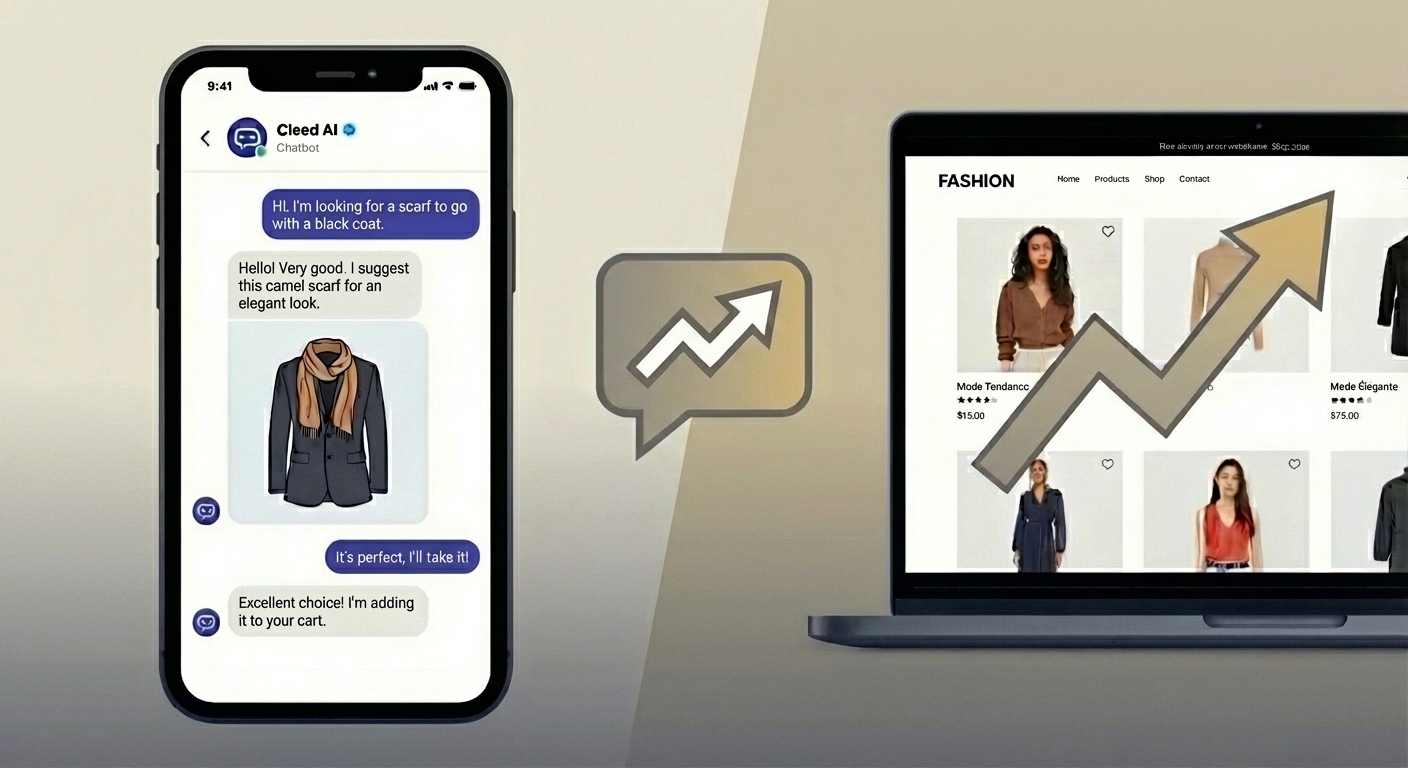
Most French-language advice on agentic commerce is telling you to do something that is no longer possible. It recommends integrating ChatGPT Instant Checkout. That feature no longer exists.
This article sets out what actually happened, where France stands today, and the work that pays off now, in a market where agentic checkout is not yet available.
What happened to in-chat checkout
OpenAI and Stripe published the Agentic Commerce Protocol on 29 September 2025, alongside a feature called Instant Checkout that let a shopper complete a purchase without leaving ChatGPT. Etsy sellers went live first, and over a million Shopify merchants were announced as coming.
On 6 March 2026, The Information reported that the feature had been pulled, and OpenAI confirmed it days later. Depending on the count, fewer than fifteen to fewer than thirty merchants had ever gone live. OpenAI's stated reason was that the initial version lacked the flexibility it wanted, and it repositioned ChatGPT towards product discovery, with checkout returning to merchants' own sites.
Two things are worth separating here. The consumer feature failed. The protocol did not: ACP remains published under Apache 2.0, and its April 2026 release added cart, feed, orders, authentication and MCP compatibility. But a specification is not a surface. Building against a standard with no live implementation is exactly how merchants lost integration time in the last cycle.
Where Google stands, and why it matters more
Google announced the Universal Commerce Protocol on 11 January 2026 at NRF, co-developed with Shopify and backed by Etsy, Wayfair, Target, Walmart and more than twenty payment and commerce partners. The March 2026 update added cart, catalog and identity linking, plus simplified onboarding through Merchant Center. At Google I/O in May, Universal Cart was introduced: a single cart spanning several retailers across Search, Gemini, YouTube and Gmail, with the retailer remaining merchant of record.
This is more serious than the ChatGPT episode, because it is built on infrastructure merchants already use. But it comes with a decisive detail for a French retailer: UCP checkout is available to selected US merchants, with expansion announced for Canada, Australia and the UK by the end of 2026. France is not on that list.
What did change in France, on 22 July 2026
On that date Google switched on AI Overviews and AI Mode for search in France, a launch delayed roughly two years by the neighbouring-rights dispute with press publishers.
The conversational interface is live. The transactional features are not. Which means a French merchant is in a very specific position: your products can now be recommended, compared and summarised inside an AI answer, but they cannot yet be bought there.
That gap is not a problem. It is a window. The French market starts after the United States, and that delay is unusual room to get ready while competitors wait to see what happens.
Why discovery is the part that pays
When checkout moved back to merchant sites, the recommendation stopped being half the mechanism and became the whole mechanism. Being named in an AI answer now decides whether you are in the consideration set at all.
Shopify reports AI traffic to its storefronts running at eight times year on year, and AI-search orders up fifteenfold. These are vendor figures, self-reported, and worth treating with the usual caution. But the direction is consistent with what merchants observe: a growing share of purchase research now happens inside an assistant, before any click.
The practical consequence: the work worth doing is the work that makes your products understandable, quotable and verifiable by a machine. None of it depends on a protocol shipping in your country.
Five things to do now
1. Mark up every product page
Product schema with name, price, currency, availability, condition, GTIN or reference, and reviews. This is what lets an engine read your page rather than merely display it. Without it, your product exists for a browser but not for an agent.
Add Organization and BreadcrumbList too, and check the result with Google's Rich Results Test rather than assuming.
2. Keep the feed genuinely live
A Merchant Center feed with stale prices or stock is worse than no feed. An answer recommending an out-of-stock product destroys trust in one interaction, and the merchant pays for that, not the engine.
Synchronise continuously, not nightly, if your catalogue moves. Availability accuracy is becoming a ranking factor in its own right.
3. Write descriptions a machine can quote
This is the least understood point. An assistant summarising your product needs verifiable facts, not adjectives. Dimensions, materials, compatibility, delivery times, return conditions. Short questions followed by short answers.
A description built on "exceptional quality" and "unique design" gives an engine nothing to work with. A specification table does.
4. Cover the questions asked before purchase
Sizing, compatibility, delivery, returns, care. These are the questions a shopper asks an assistant, and the pages that answer them precisely are the ones cited. Your customer service already knows what they are: read the last few hundred conversations.
5. Start measuring, even imperfectly
Attribution in an AI context is genuinely harder. Someone who reads an AI answer mentioning your product, then visits your site directly and buys, does not appear as an organic click on the original query.
Track what you can: direct traffic on product-intent queries, referrals identified as coming from AI assistants, and your presence in AI answers on your priority queries. Imperfect measurement started now beats perfect measurement started in a year.
What not to do
Do not build against a protocol you cannot use. As things stand, there is no agentic checkout available to a French merchant. Any plan that depends on one has an unscheduled dependency.
Do not confuse the protocol with the surface. ACP and UCP are specifications. What matters commercially is whether a consumer surface implements them in your market. Today, in France, none does for the transactional part.
Do not wait for it to settle. This is the symmetrical error. The preparation work described above improves your current performance regardless: clean structured data and an accurate feed serve your existing Shopping campaigns and your classic SEO. You are not building a parallel system, you are upgrading the only one you have.
Frequently asked questions
Can a French merchant sell through an AI agent today?
Not with in-agent checkout. Instant Checkout was withdrawn in March 2026, and UCP checkout is restricted to selected US merchants with expansion announced for Canada, Australia and the UK. Your products can be recommended in an AI answer in France; the purchase happens on your site.
Is ACP dead?
No. The specification remains published and maintained, and its April 2026 version broadened its scope considerably. What disappeared is the consumer feature that used it inside ChatGPT.
Should I redo my SEO for AI?
Largely, no. Structured data, page speed, accurate information and content that answers real questions have always been good SEO. What changes is that these elements now determine whether you are quoted, not just whether you rank.
How do I know if my products appear in AI answers?
Ask the questions yourself, on your priority queries, in AI Mode and in the assistants your customers use. It is crude, but it is currently the most reliable method available.
The window is open, and it will not stay open
France starts this cycle late, and for once that is an advantage. You can watch what worked and what failed in the United States, avoid the integration that was abandoned after six months, and arrive with clean product data on the day the transactional features cross the Atlantic.
The merchants who will be visible then are not the ones who will have integrated the fastest. They are the ones whose catalogue will already be readable, accurate and quotable, because they did that work while it looked like it could wait.