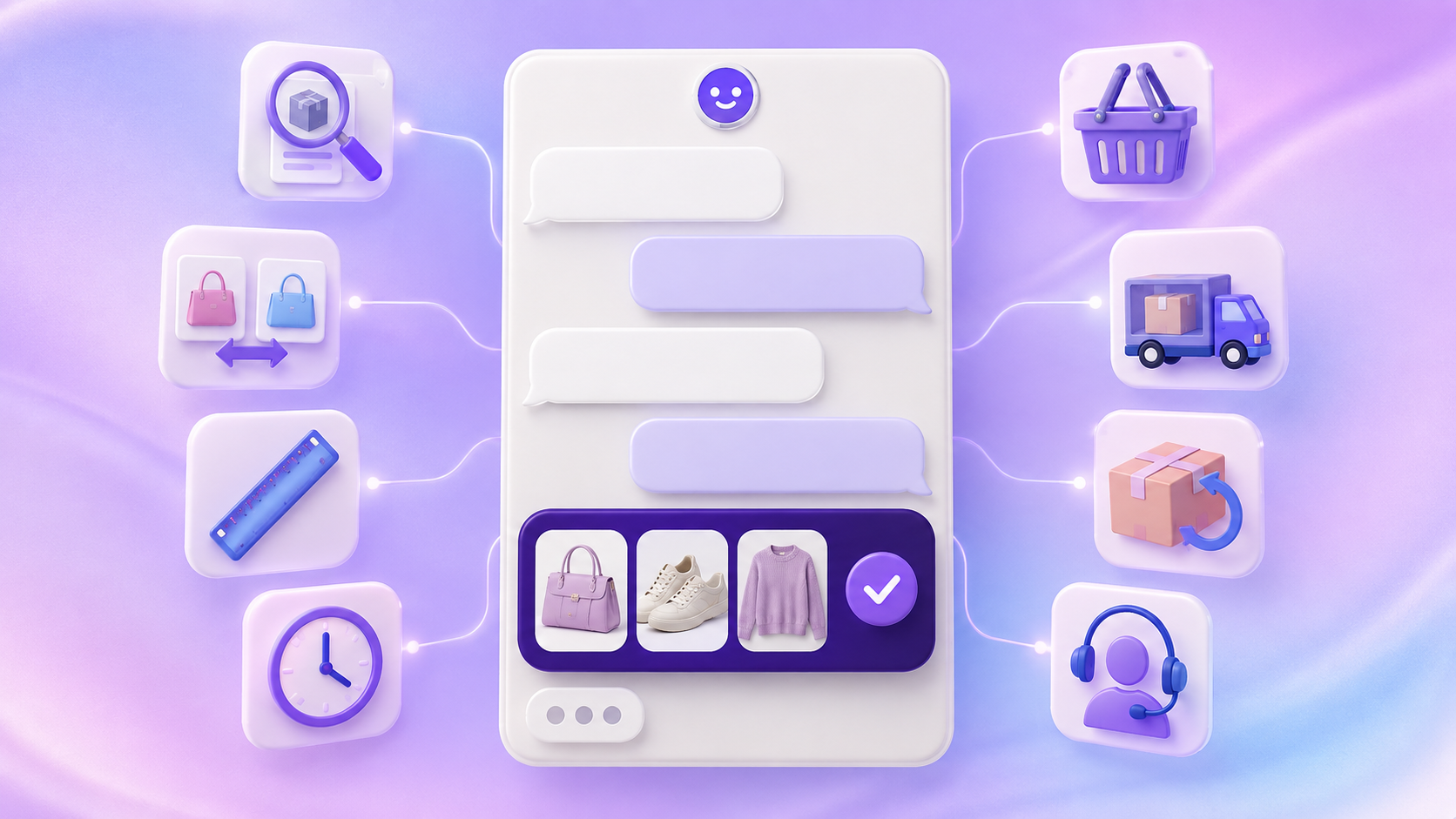
A well-designed conversational assistant does one simple thing: it answers the question blocking the purchase, at the moment it comes up. Every benefit follows from that, and it is why assistants have spread through e-commerce so quickly.
This article covers what one actually brings, the different families of solutions, what separates a good one from a poor one, and how a rollout unfolds. The aim is that you know what to expect before committing.
The three families of assistants
Three models coexist, and they do not answer the same needs.
Rule-based chatbots follow predefined scenarios, with buttons and if-then logic. They are reliable on well-marked tasks such as order tracking, frequent questions and return conditions, and they stop as soon as a question leaves the script. Their advantage is predictability: they never say anything unexpected.
AI assistants understand a freely phrased question, even a clumsy one, and reason over your catalogue and your content. That is what enables product advice, comparison between references and open questions. In exchange, their relevance depends on the quality of the information they are connected to.
Hybrid assistants combine the two: strict rules where accuracy is critical, AI for the rest, and a handover to a human advisor when the situation calls for it. This has become the standard on mature sites, because it covers the whole journey without sacrificing reliability on sensitive subjects.
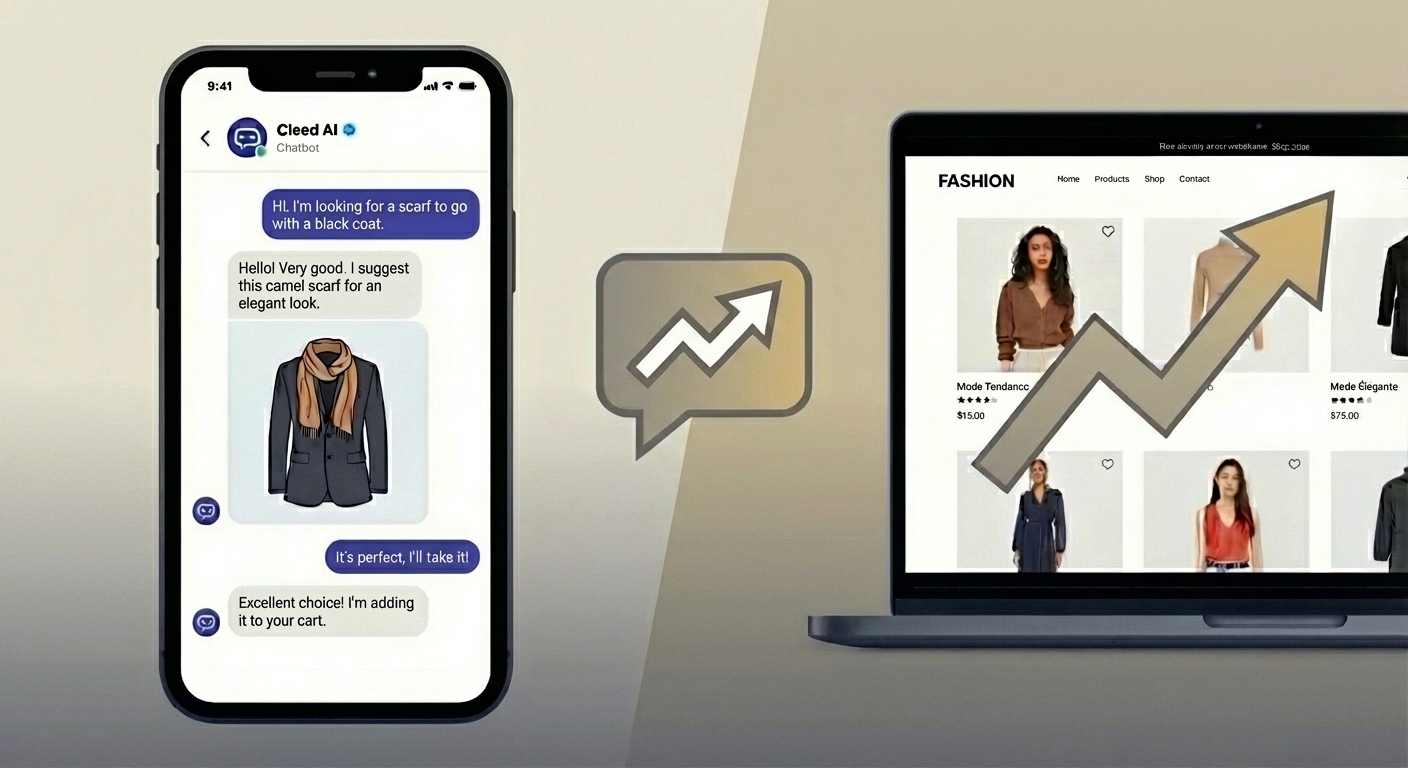
The most developed form of that third model is the personal shopping assistant, which no longer just answers but accompanies the sale. That is the approach behind Cleed.ai, whose assistant knows the merchant's catalogue, brand and business rules.
What an assistant changes, benefit by benefit
Removing doubt before purchase
This is the most direct effect. Most visitors who leave without buying do not leave because the product is wrong, but because a piece of information was missing at the moment it mattered: a size, a compatibility, a delivery time, the difference between two references.
These doubts arrive at the worst moment, just before the add to cart. An assistant that answers precisely, in context, turns hesitation into a decision. Based on results observed across Cleed.ai clients in 2025, visitors who use the assistant can convert up to six times more than those who do not.
Guiding product discovery
Internal search assumes the shopper thinks in your taxonomy. They think in needs: a gift for someone starting out, something compatible with what they own, an option that fits a budget.
Conversation absorbs that phrasing naturally and translates it into a recommendation. On a large or technical catalogue, it closes a gap no filter system has really closed. That is the logic behind product finder and gift finder applications, which start from the need expressed rather than from your site structure.
Lifting average order value
An assistant that has understood the real need suggests a relevant complement, where the generic cross-sell block gets ignored. The suggestion lands because it arrives inside a conversation where the need has just been expressed.
Taking repetitive requests off your support team
Where is my order, what is the delivery time, how do I return this, where is my invoice. A large share of support volume comes down to a handful of questions asked thousands of times.
Automating them changes what your team spends its days on: instead of copying tracking numbers, they handle the situations that need judgement, a commercial decision or empathy. Service quality usually rises rather than falls.
Reducing cart abandonment
Part of abandonment comes from questions that surface late: shipping costs discovered at the last step, an uncertain delivery date, a return policy nobody can find. An assistant present at that moment, without pulling the shopper out of the funnel, often unblocks the purchase in one exchange.
Answering outside working hours
Your customers browse in the evening, at weekends, from other time zones. The decision window sometimes lasts minutes. An assistant does not replace a team available around the clock, but it removes the silence that sends people off to compare elsewhere.
Surfacing what your site fails to explain
An assistant records the questions asked. It is the most direct list of objections you will get, and more reliable than a satisfaction survey because nobody is performing.
When the same question keeps coming back, it is not a support issue: it is a sign that a product page or a delivery page would benefit from being more explicit. The assistant becomes a tool for prioritising improvements to the site itself.
Extending the relationship after purchase
Tracking, delivery incidents, returns, product usage: the post-purchase phase generates as many questions as the pre-purchase one, and it is where loyalty is decided. An assistant connected to order status extends the relationship instead of letting it drop after payment.
How to choose: five criteria that matter
Demos all look alike. These five points usefully separate them.
- Ease of deployment. Can you launch without tying up developers? Technical integration now comes down to a single line of JavaScript with most vendors.
- Quality of connections. Does the assistant genuinely plug into your catalogue, your inventory and your orders, or does it just read your pages?
- Control. Do you own the tone, the design, and above all the scope: what the assistant handles and what it does not?
- Real intelligence. Does it understand a badly phrased question, or only recognise keywords? Test with your own customer questions, not the ones in the demo.
- Pricing clarity. Does the model stay predictable as your traffic grows?
One practical filter: for every feature presented, ask how it concretely helps a visitor place an order. If the answer is vague, so is the feature.
How a rollout unfolds
The timeline is now measured in hours or days rather than months, with no site rebuild.
Define the goal. Improve conversion, recover carts, lighten support: everything follows from that, from configuration to tone. A sales-oriented assistant is not set up like a support-oriented one, and confusing the two is the most common mistake.
Connect the data. Catalogue, inventory, site content, order status. The good news is that most of it already exists on your site. It is mainly a matter of checking that your delivery, returns and warranty pages say what your team says on the phone.
Set the handover rules. Which cases the assistant handles alone, when it passes over, and what happens outside working hours. Half a day of scoping prevents most bad experiences.
Pick a metric before launching. Conversion rate, average order value or support contact rate. Without a metric defined in advance, evaluation afterwards is guesswork.
One reassuring point: nothing requires covering everything on day one. Many merchants start narrow, on one category or on delivery questions alone, then widen once the first results are measured.
Two assumptions, and one decisive factor
"It will replace my customer service"
No, and that is not desirable. An assistant absorbs the repetitive layer, which is a thick one, and frees your advisors for situations that need a person. Projects built on a headcount-reduction case almost always disappoint.
"Product data can wait"
An assistant does not create information that exists nowhere: it makes reachable what already exists. The more exploitable attributes your product pages carry, such as measurements, materials and compatibilities, the more precise the advice.
This work is never wasted: structured product data also improves your search visibility, your Shopping campaigns and your presence in AI-generated answers. You are not building a parallel project, you are improving the only one you have.
The decisive factor: what the assistant is connected to
With the same solution in place, the gap between two stores almost always comes down to the same six elements. None is heavy, and most are already in place.
- Delivery, returns and warranty pages that are current and say what your team says on the phone.
- Exploitable product attributes: measurements rather than a size chart image, a compatibility field rather than a mention buried in a paragraph.
- Inventory synced in real time, so an out-of-stock item is never recommended.
- Access to order status, without which the assistant only answers the generic half of post-purchase questions.
- A clear rule for handing over to a human, including outside working hours.
- Someone who reads, once a month, the questions that went unanswered.
The first three belong to your catalogue, the last three to your organisation. It is usually the second half that gets forgotten, even though it is the quicker one to put in place.
Where to start
There is no need to be ready on every front. Three things are enough to start usefully.
Check that your delivery, returns and warranty pages are current, which is the foundation and is often already in place. Choose a narrow starting scope, where you know you are losing sales. And name someone who will look, once a month, at the questions the assistant could not handle: that is what turns a tool into a compounding advantage.
The rest builds up over the months, as you see what pays on your own site.
Frequently asked questions
What is the difference between a chatbot and an AI shopping assistant?
Level of initiative. A chatbot answers what it is asked. An assistant anticipates the need, recommends specific products from your catalogue and can trigger actions such as adding to cart or proposing an alternative when an item is unavailable.
How much does an e-commerce AI assistant cost?
Three models coexist: a fixed monthly subscription, per-conversation or per-session pricing, or a model indexed on generated revenue. The right criterion is not absolute cost but the ratio to the gain on your own traffic, which a short trial period lets you estimate before committing.
How do I add an assistant to my site?
In three steps: connect the assistant to your product data and content, configure it around your priority scenarios, then deploy it through a script or a native integration with your platform. No development is required on your side.
How long does deployment take?
Days to weeks depending on scope. The technical part is quick; scoping and content preparation determine the timeline.
Does it work on a small catalogue?
The benefit grows with catalogue complexity and with the share of purchases that involve a real choice. On ten simple products, clear product pages and a good FAQ may already be enough.
How do I measure whether it works?
Compare conversion and average order value between assisted and non-assisted sessions, track the share of requests resolved without a human, and look at escalations and their reasons.
In short
A conversational assistant does not add another layer to your site: it makes what you have already published usable at the moment it matters. That is why it acts on conversion, on support load and on satisfaction at the same time.
Deployment is simpler than it looks, and it happens in stages. What sets apart the merchants who get the most from it is not the sophistication of the tool they chose, but the care given to what the assistant is allowed to say, and how regularly they listen to what it teaches them.
The best way to settle it is to try it on your own catalogue. Cleed.ai offers a 30-day free trial using your real products and site content, or a 30-minute demo built around a use case relevant to your brand.