
Choosing an e-commerce CMS is rarely settled by a feature checklist. The three platforms that dominate the French market all handle a catalogue, a cart and a payment. The question that matters is a different one: which platform fits your organisation, your catalogue, and your ability to maintain it three years from now.
This guide draws on 2026 data from the French market and adds three criteria that did not exist during the last redesign cycle: accessibility compliance, which is now mandatory, performance as measured by Google, and whether your store can be found by AI agents.
What the French market actually shows
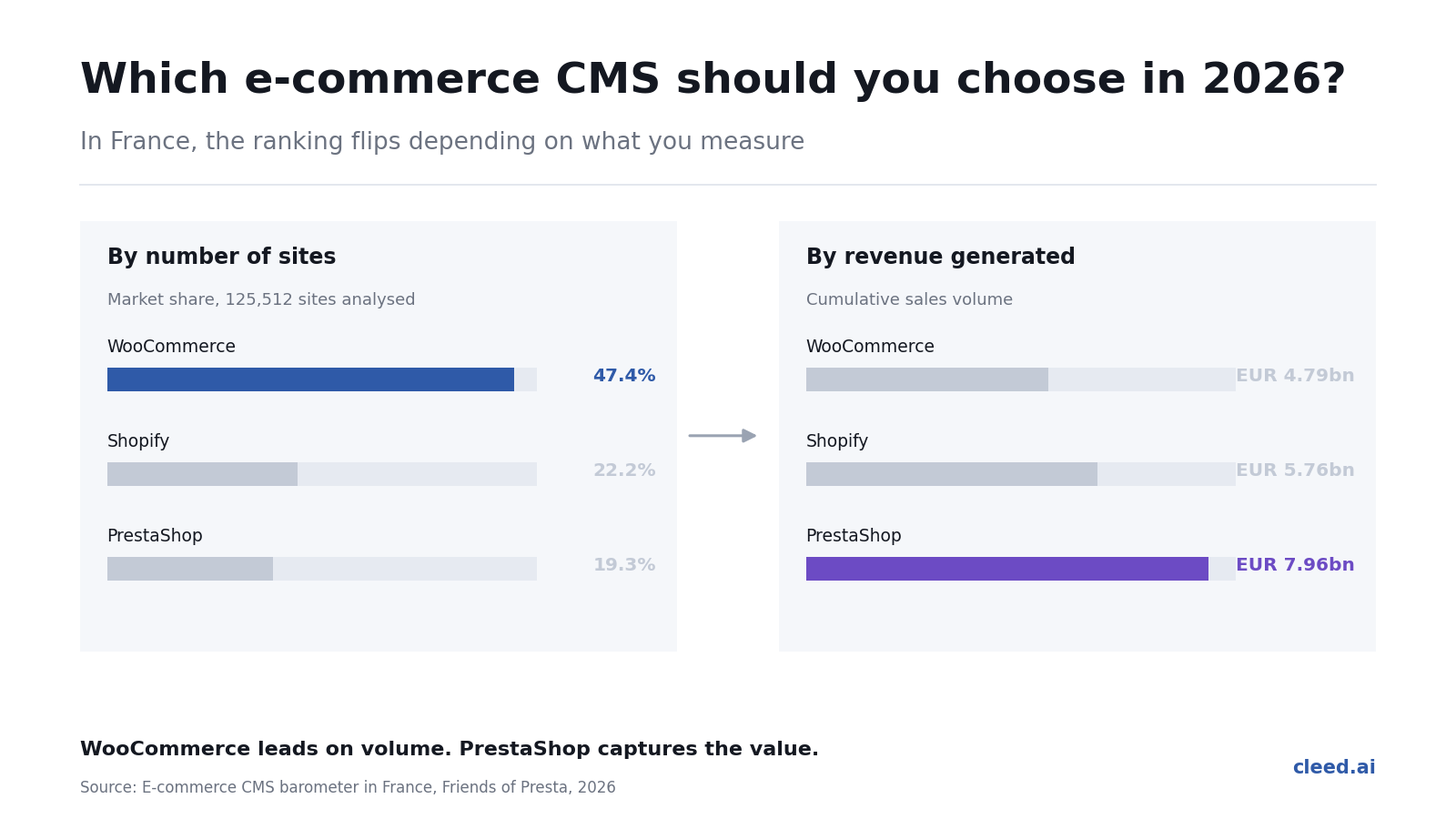
The first barometer of e-commerce CMS platforms in France, published in early 2026 by Friends of Presta, analysed more than 125,000 active stores, roughly 82% of the market estimated by the Fevad. It is the most reliable picture available today, and its main finding is a reversal.
By number of sites: WooCommerce leads with 47.4% (around 59,500 stores), ahead of Shopify at 22.2% and PrestaShop at 19.3%. Together, close to 9 French stores out of 10.
By revenue generated, the ranking flips: PrestaShop accounts for 7.96 billion euros, ahead of Shopify at 5.76 billion and WooCommerce at 4.79 billion.
The explanation lies in the structure of the French merchant base: more than half of e-commerce sites are run with no employees at all. That mass of very small stores inflates WooCommerce volumes without moving revenue.
The third figure is the most instructive. Among sites above 40,000 monthly visitors, PrestaShop shows a performance rate of 3.06%, Shopify 2.52%, WooCommerce just 0.49%. In other words, the most widely used CMS is also the one that falls away fastest as a store grows.
The practical conclusion: picking a platform because it is the most popular is reasoning that puts you in the wrong category. The real question is which segment you are in, and which one you are aiming for.
Three criteria that changed since your last redesign
1. Accessibility is no longer optional
The European Accessibility Act now applies to e-commerce services aimed at European consumers. Purchase journeys, product pages, checkout: everything must be keyboard-operable, properly contrasted, with labelled forms and explicit error messages.
The risk is not only legal. An unlabelled form field or an incomprehensible payment error costs sales every day, from every visitor.
For the CMS decision: default themes are not equivalent. PrestaShop made compliance an explicit priority with its Hummingbird 2 theme, announced at over 95% EAA conformance. On WooCommerce, accessibility depends entirely on the theme and the extensions you stack, which is to say on you.
2. Performance drives your search visibility
Core Web Vitals are not a technical footnote. Slow loading or content that shifts as the page renders weigh on both your position in Google and your conversion rate.
This is exactly what gives the WooCommerce drop-off above 40,000 monthly visitors its meaning: a WordPress-plus-extensions architecture, stacked without arbitration, becomes hard to hold together on performance.
3. Your products need to be readable by AI agents
This criterion appeared in no comparison two years ago, and it is becoming structural.
Agentic commerce, where an AI agent searches, compares and buys on a customer's behalf, has left the experimental stage. The Agentic Commerce Protocol was published by OpenAI and Stripe in September 2025. Google launched its Universal Commerce Protocol at NRF in January 2026, with more than twenty partners including Shopify, Etsy, Zalando, Stripe, Visa and Mastercard. AI referral traffic to US retail sites grew close to fivefold year over year in the first quarter of 2026.
What matters for your CMS choice is the quality and exposure of your product feed. A poorly structured catalogue is simply invisible to these agents. Shopify has taken a considerable lead here, with its merchants integrated by default into the main surfaces. On open-source platforms this is work to be done, and the new REST API in PrestaShop 9, built on API Platform, makes exactly this kind of exposure easier.
The platforms, one by one
WooCommerce: the entry point

Model: a free WordPress extension, self-hosted.
Real cost: hosting, domain name, theme, paid extensions, maintenance. No platform subscription, no commission on sales.
Who it suits: a physical shop selling online as a complement, a limited catalogue, a running cost to keep minimal. At small volumes, having no monthly subscription is hard to beat.
The limits: performance beyond a few tens of thousands of monthly visitors, and the technical debt that accumulates as extensions pile up. Every extension is a point of failure, a potential vulnerability and a slowdown.
Shopify: the platform capturing new merchants

Model: SaaS. Hosting, security, SSL certificate and updates included.
2026 pricing (US pricing, monthly billing; annual billing cuts roughly 25% and prices vary by country, so check the official page for your market): Starter at 5 dollars, a payment link rather than a store. Basic at 39 dollars, with online transaction fees of 2.9% plus 30 cents. Grow at 105 dollars, 2.7% plus 30 cents. Advanced at 399 dollars, 2.5% plus 30 cents. Plus from 2,300 dollars, with negotiated rates.
Two traps. The former Shopify plan was renamed Grow in 2026: same plan, new name. And more importantly, the listed price is not your real cost: if you do not use Shopify Payments, a surcharge applies to every transaction, up to 2% on Basic. On top of that come the theme, the apps and the domain.
Who it suits: a merchant who wants to sell without becoming a system administrator. It is the rational choice for most small businesses and new launches, and it is best placed on agentic commerce.
The limits: you are renting infrastructure you do not control. Costs rise with volume, and deep checkout customisation stays reserved for the higher plans.
PrestaShop: the French open source that captures the value
Model: open source, self-hosted, no commission on sales.
This is the platform of businesses that last: fewer sites, but the largest cumulative revenue in the French market and the best resilience on heavy traffic. It is also far more connected to marketplaces, at 16.7% of PrestaShop sites against 8.8% of Shopify sites.
Where the versions stand in 2026, worth knowing before any project:
- PrestaShop 1.7 and earlier: support has ended. Unpatched security flaws, PHP incompatibilities. Migrate urgently.
- PrestaShop 8.2: stable, but now receives only limited security fixes.
- PrestaShop 9.1: the reference stable version since early 2026. Symfony 6.4 LTS foundation, PHP 8.1 minimum, new REST API, native WebP and AVIF optimisation, Hummingbird theme.
- PrestaShop 9.2: expected late 2026.
One caution: migrating from 1.7 straight to 9 is not officially supported, you have to pass through a version 8 first. And moving to 9 removes the controllers inherited from 1.6, which breaks compatibility for some modules. A prior audit is not a luxury.
Who it suits: a complex catalogue, specific business rules, a marketplace presence, and someone, in-house or at an agency, to look after it.
Magento and Adobe Commerce: the top of the range

The name changed, and so did the structure. Today you have to distinguish:
- Magento Open Source: the free, self-hosted edition, around 160,000 sites worldwide.
- Adobe Commerce: the licensed edition, with native B2B, Page Builder, customer segmentation and Adobe support.
- Adobe Commerce Cloud: the same, with hosting managed by Adobe.
Two developments matter. Mage-OS, a community-governed fork, exists to guarantee the open-source branch a future independent of Adobe's commercial priorities. And Hyva has established itself as the de facto modern front end, replacing the Luma architecture.
One point to close for good: Magento 1 reached end of life in June 2020. No fixes, no security patches. A store still running on it does not need a maintenance plan, it needs a migration plan.
Who it suits: very large catalogues, multi-store, multi-currency, B2B with account hierarchies and contract pricing. Adobe Commerce remains the B2B reference. In exchange, the entry ticket in skills and budget is the highest on the market.
How to decide, concretely
Ask yourself these questions in order.
- Who will look after it day to day? If the answer is nobody in particular, go SaaS. An open-source platform with no one maintaining it is a debt that keeps running.
- What volume are you aiming for in 24 months? Below 40,000 monthly visitors, everything works. Above it, architecture becomes decisive.
- Is your catalogue standard? Simple products and classic variants: any platform will do. Configurators, per-customer pricing, multi-warehouse stock rules: you are in PrestaShop or Adobe Commerce territory.
- Do you sell B2B? If so, with account hierarchies and negotiated prices, the list narrows fast.
- What does leaving cost you? Nobody asks this one. Migrating means several months and a serious budget. Choose the platform you will be able to sustain, not the one you like today.
Agency or in-house?
The 2020 reasoning still holds, with one nuance.
With an agency: expertise available from day one, capacity to absorb peaks such as launches, migrations and peak season, and payment for outcomes rather than a permanent headcount.
In-house: relevant if you already employ developers skilled on the platform and your roadmap is full enough to keep them busy. Otherwise you are paying for a skill you are not using.
The hybrid model has become the norm: a small internal team, an agency for specialist work and overflow.
Frequently asked questions
What is the best e-commerce CMS in 2026?
None is best in the abstract. For a small business launching without technical skills, Shopify. For very small volumes with minimal running costs, WooCommerce. For a complex catalogue with technical resources, PrestaShop. For B2B at scale, Adobe Commerce.
Should you migrate to PrestaShop 9?
On 1.7 or earlier, yes, and quickly: support has ended. On a recent version 8, there is no urgency, plan it calmly. For a new build, go straight to 9.
What does Shopify really cost?
The subscription is only one of three layers. Add card processing fees on every sale, the surcharge if you do not use Shopify Payments, then the theme, the apps and the domain.
Does my CMS affect my SEO?
Indirectly but genuinely, through performance, URL structure, control over meta tags and accessibility. No platform does SEO for you.
What about Magento 1?
Nothing. End of life since June 2020, no security fixes. Any store still on it must migrate.
The CMS is only a foundation
One closing point, because it is systematically left out of comparisons like this one: the platform determines what you can build, not what you will sell.
Across the three main platforms, the conversion gap between two comparable stores almost never comes from the CMS. It comes from how the visitor is guided: do they find the right product, do they get an answer about sizing or delivery times, are they re-engaged at the right moment.
It is also what prepares you best for agentic commerce. Clean, structured, queryable product data serves both your human visitors and the AI agents that will come looking for your products.